
2025 / Human Brain Mapping / Article
Head Motion in Diffusion Magnetic Resonance Imaging: Quantification, Mitigation, and Structural Associations in Large, Cross-Sectional Datasets Across the Lifespan
Summary
Across 13 cohorts spanning infancy to old age, this study characterizes head motion and its relationship to diffusion MRI measurements. Scan–rescan comparisons examine the effectiveness of modern preprocessing, while population analyses investigate structural associations with motion. The findings help distinguish acquisition artifacts from differences associated with the people who move.
Study overview
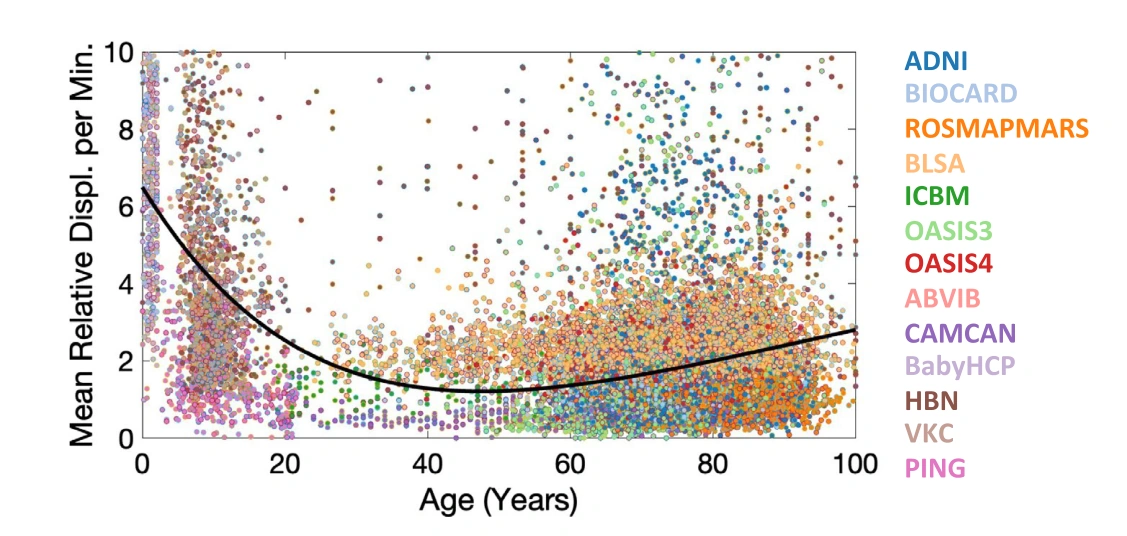
Head motion can distort diffusion MRI and bias tissue measurements, but its patterns vary across individuals and populations. This study analyzes 13 cohorts spanning ages 0.1–100 years to describe motion magnitude, direction, and associations with participant characteristics. It also uses repeated scans with different motion levels to evaluate modern preprocessing and examines whether high- and low-motion groups differ in structural connectivity. The results indicate that contemporary processing can substantially mitigate detectable motion-related measurement bias in the tested comparisons. At the same time, associations between motion propensity and anatomy warrant care when interpreting between-person differences or selecting data for analysis.
Main findings
- Describes motion patterns across 13 cohorts spanning infancy through late life.
- Repeated scans test whether preprocessing mitigates differences associated with motion.
- Motion propensity can relate to structural connectivity, complicating population comparisons.
Cite this work
Kurt G. Schilling et al. · Last author: Bennett A. Landman (2025). Head Motion in Diffusion Magnetic Resonance Imaging: Quantification, Mitigation, and Structural Associations in Large, Cross-Sectional Datasets Across the Lifespan. Human Brain Mapping. https://doi.org/10.1002/hbm.70143
This page summarizes the work; consult the original article for the complete methods, results, and qualifications.