
2026 / Human Brain Mapping / Article
Lifespan Trajectories of Asymmetry in White Matter Tracts
Summary
White matter asymmetry changes with age and depends on which tissue or pathway feature is measured. Using 35,120 individuals from 50 studies, this work charts 30 paired pathways from birth to 100 years. It provides a reference for interpreting lateralization across development and aging.
Study overview
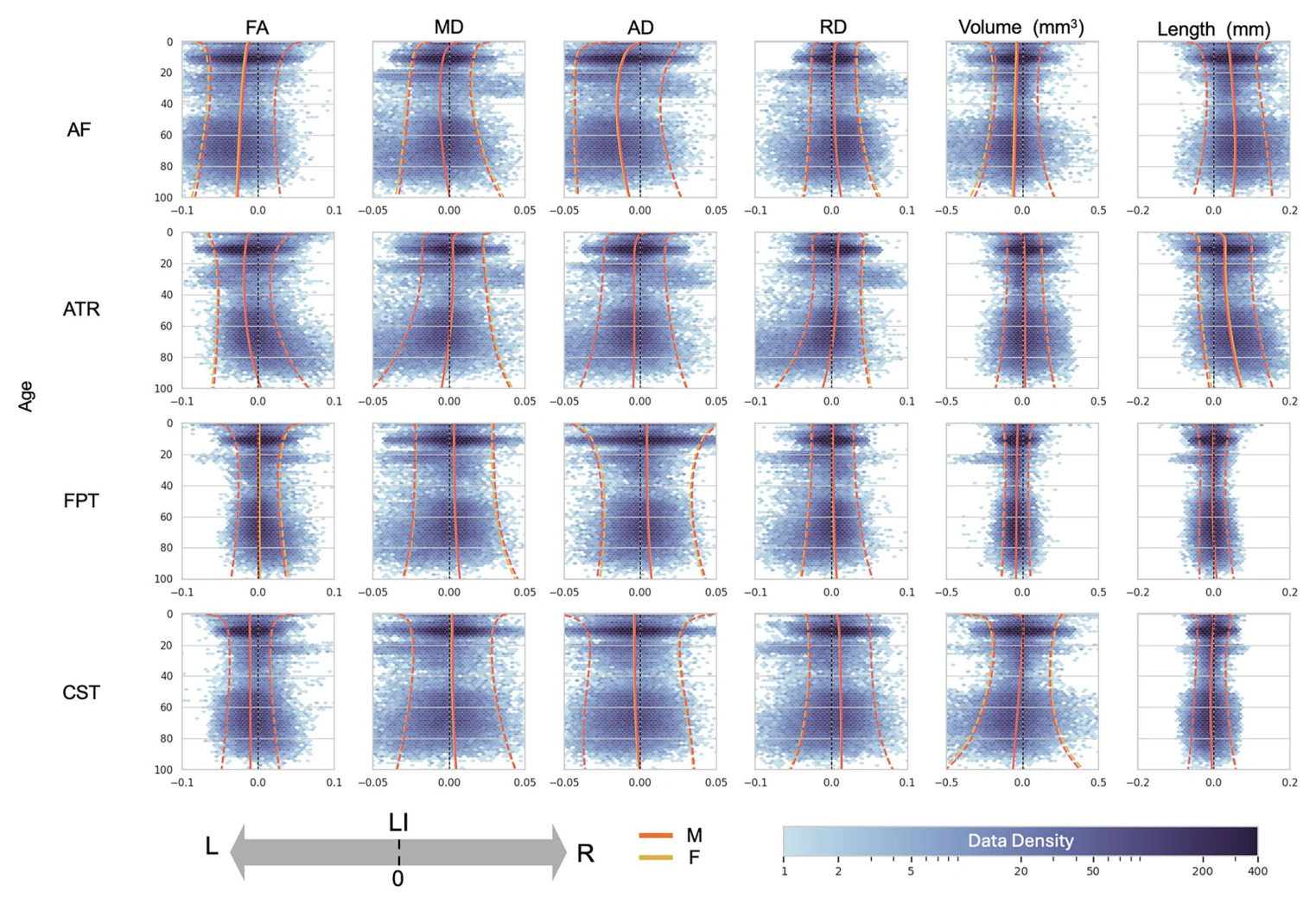
The study combines data from 50 primary imaging studies to characterize white matter asymmetry in 35,120 typically developing and aging individuals. Lifespan models describe six microstructural and macrostructural features across 30 lateralized association and projection pathways. Asymmetry is present in every pathway, but its direction and magnitude can differ between measurements of the same tract. The patterns also change across life, with many pathways becoming more asymmetric in later adulthood. These charts establish a reference for studying how hemispheric differences emerge and evolve, and for evaluating departures from typical organization in future clinical and cognitive studies.
Main findings
- All 30 examined pathways showed asymmetry.
- Asymmetry direction and magnitude depend on the structural feature measured.
- Trajectories change with age, with a general increase in asymmetry during later adulthood.
Cite this work
Sam Bogdanov et al. · Last author: Kurt G. Schilling (2026). Lifespan Trajectories of Asymmetry in White Matter Tracts. Human Brain Mapping. https://doi.org/10.1002/hbm.70519
This page summarizes the work; consult the original article for the complete methods, results, and qualifications.