
2022 / Magnetic Resonance Imaging / Article
Minimal number of sampling directions for robust measures of the spherical mean diffusion weighted signal: Effects of sampling directions, b-value, signal-to-noise ratio, hardware, and fitting strategy
Summary
Simulations and brain and spinal cord measurements establish how many diffusion directions are needed to estimate the spherical mean signal reliably. A lookup table links sampling requirements to diffusion weighting, signal-to-noise ratio, and fitting choices.
Study overview
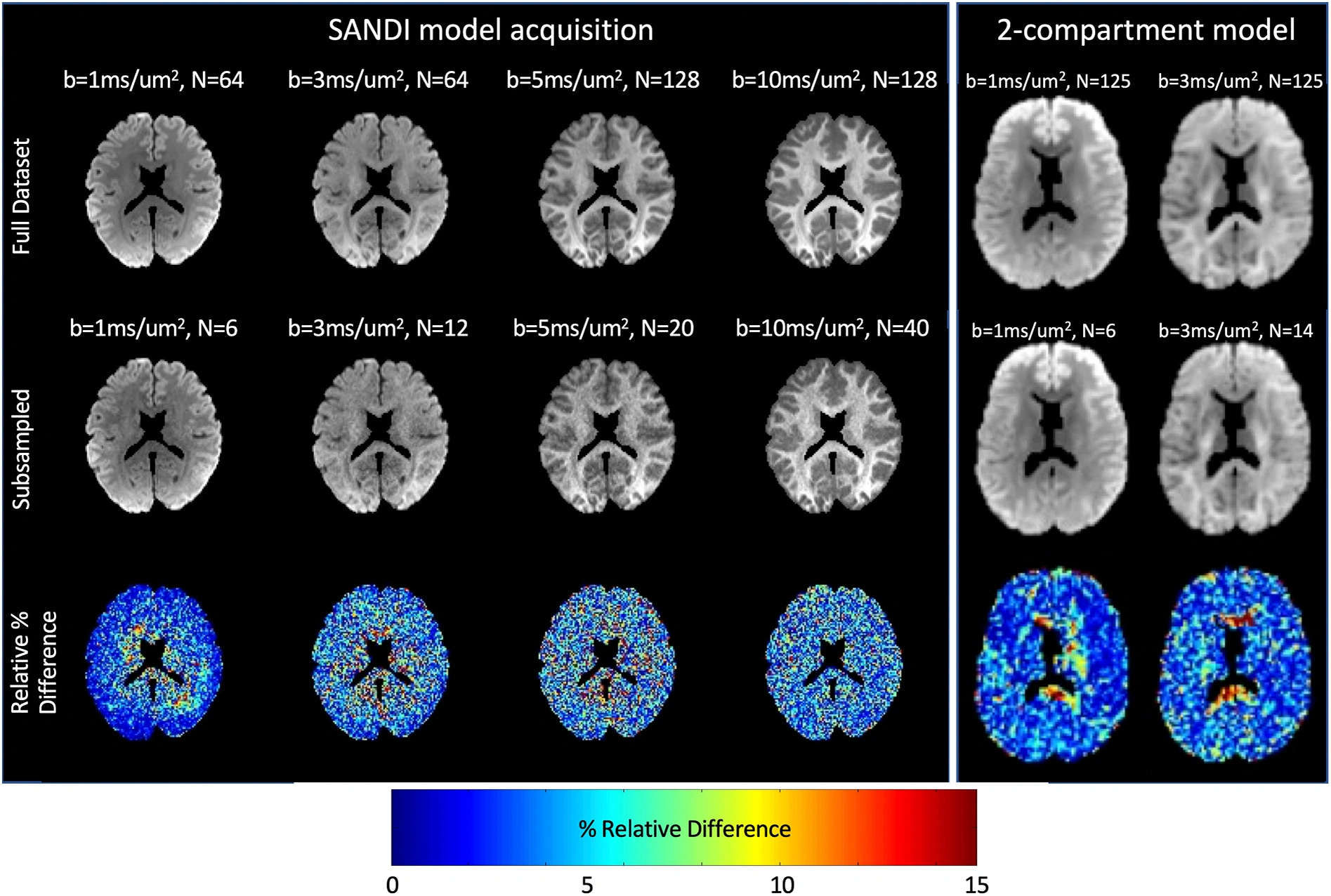
Spherical-mean diffusion models can support efficient microstructural imaging, but their accuracy depends on directional sampling. This work varies the number of directions, b-value, noise level, hardware, and fitting strategy in simulations, then checks those predictions with brain and spinal cord data. The resulting guidance helps balance acquisition time against measurement precision.
Main findings
- Directional sampling requirements depend on b-value, noise, and fitting strategy.
- Empirical brain and spinal cord measurements agreed with the simulations.
Cite this work
Kurt G. Schilling, Marco Palombo, Kristin P. O'Grady, Anna J.E. Combes, Adam W. Anderson, Bennett A. Landman, Seth A. Smith (2022). Minimal number of sampling directions for robust measures of the spherical mean diffusion weighted signal: Effects of sampling directions, b-value, signal-to-noise ratio, hardware, and fitting strategy. Magnetic Resonance Imaging. https://doi.org/10.1016/j.mri.2022.07.015
This page summarizes the work; consult the original article for the complete methods, results, and qualifications.