2020 / PLOS ONE / Article
Distortion correction of diffusion weighted MRI without reverse phase-encoding scans or field-maps
Summary
A second-generation Synb0 pipeline uses three-dimensional deep learning to create an undistorted diffusion reference from available MRI data. It supports distortion correction when reverse phase-encoding scans or field maps are missing, extending practical preprocessing options for historical and heterogeneous datasets.
Study overview
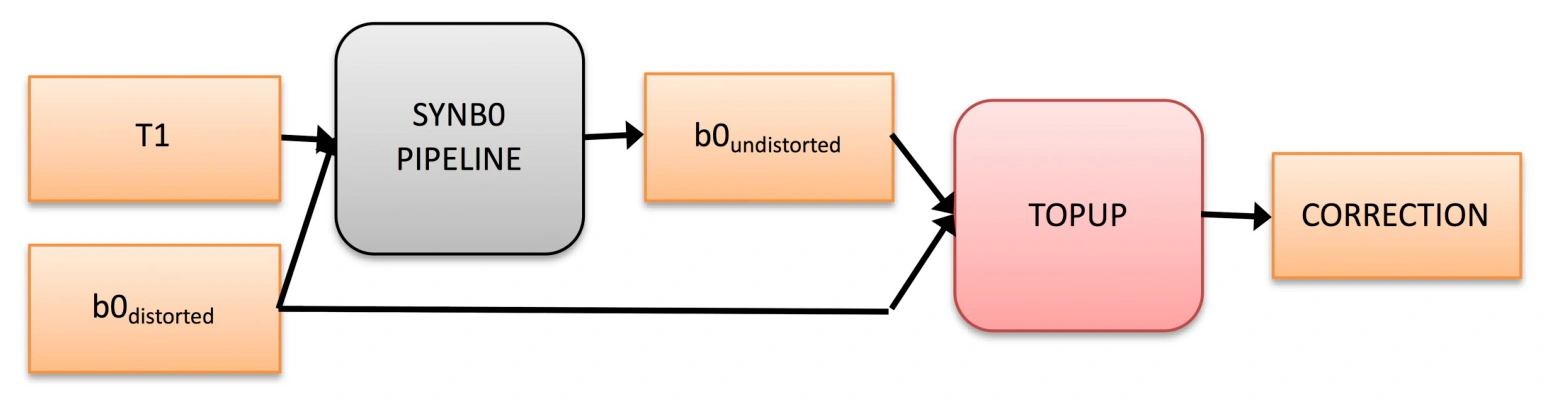
The study develops a three-dimensional U-net approach to synthesize an undistorted b0 image with structural T1-weighted geometry and diffusion-like contrast. A heterogeneous training dataset was used to improve applicability across acquisition conditions, and performance was evaluated on withheld data against standard reversed phase-encoding correction and intensity-based registration. The synthesized target enabled correction of geometric distortions without collecting an additional field map or opposite-encoding scan. This extends the earlier Synb0-DisCo method and reduces reliance on computationally intensive registration alone. Because the target is synthesized, unusual anatomy, contrast, or acquisition conditions still require quality control; successful correction in the test set is not a guarantee for every new scan.
Main findings
- The pipeline used three-dimensional U-nets and heterogeneous training acquisitions to synthesize an undistorted b0 image.
- Withheld test data showed successful geometric distortion correction without additional correction scans.
- The proposed approach was quantitatively compared with intensity-based registration and FSL TOPUP.
Cite this work
Kurt G. Schilling et al. · Last author: Bennett A. Landman (2020). Distortion correction of diffusion weighted MRI without reverse phase-encoding scans or field-maps. PLOS ONE. https://doi.org/10.1371/journal.pone.0236418
This page summarizes the work; consult the original article for the complete methods, results, and qualifications.