2026 / Brain Structure and Function / Review
Did you know? State-of-the-art preprocessing diffusion MRI data can improve tractography
Summary
This review explains how modern diffusion MRI preprocessing improves the anatomical fidelity and repeatability of tractography. It brings together evidence for denoising and correction of motion, eddy currents, susceptibility distortion, and Gibbs ringing. Practical acquisition advice and integrated pipelines help researchers apply these methods consistently.
Scope
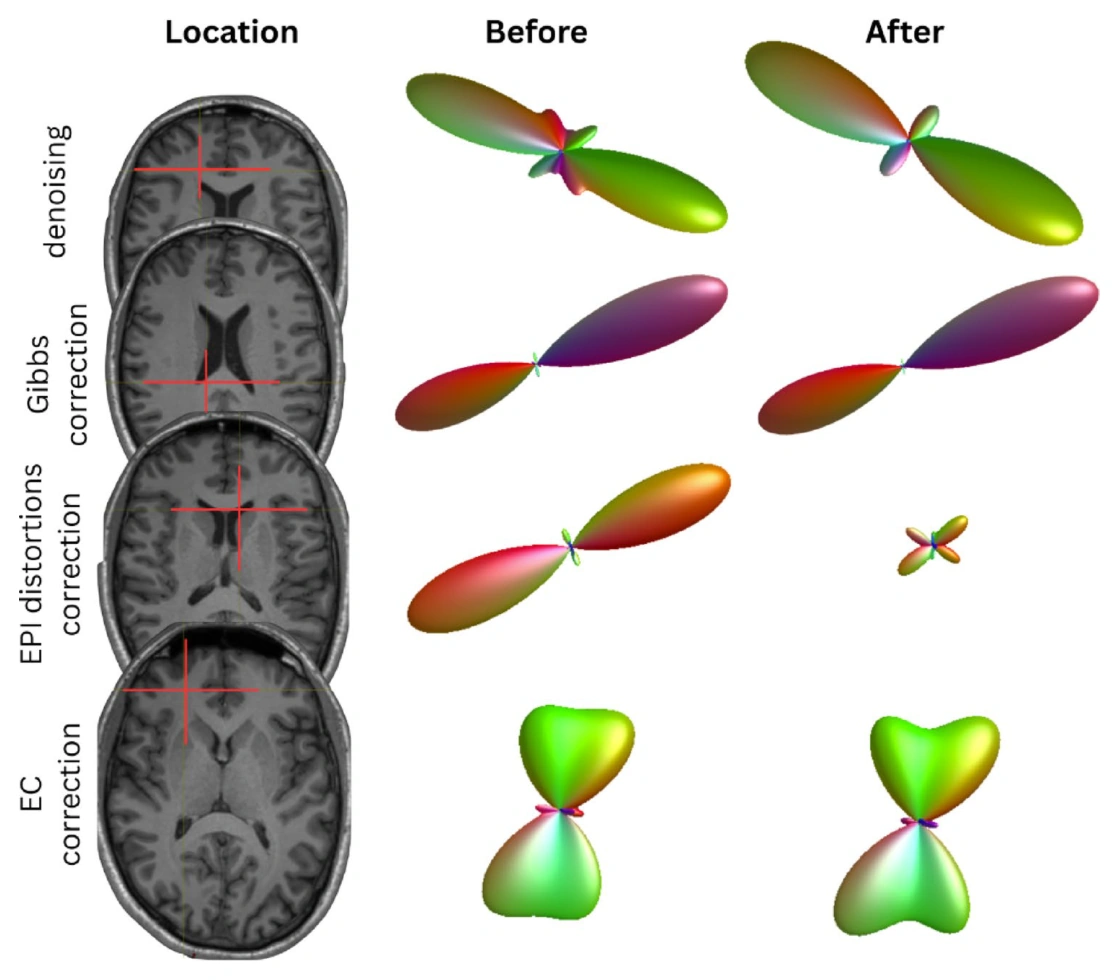
Tractography depends on estimates of local fiber orientation, so image noise and artifacts can propagate into reconstructed pathways. This review synthesizes evidence comparing modern preprocessing with minimally processed diffusion data. It covers denoising, motion and eddy-current correction, echo-planar distortion correction, and Gibbs-ringing removal, alongside emerging processing steps. The authors also describe publicly available integrated pipelines and practical acquisition and data-handling choices that enable effective correction. The article provides a methodological guide for improving anatomical fidelity and scan–rescan reproducibility, while emphasizing that reliable reconstruction starts with careful treatment of the underlying diffusion images.
Topics covered
- Image artifacts propagate into orientation estimates and reconstructed tracts.
- Modern preprocessing can improve anatomical fidelity and repeatability.
- Integrated public pipelines support standardized application of correction methods.
Cite this work
Kurt G. Schilling et al. · Last author: Jelle Veraart (2026). Did you know? State-of-the-art preprocessing diffusion MRI data can improve tractography. Brain Structure and Function. https://doi.org/10.1007/s00429-026-03107-7
This page summarizes the work; consult the original article for the complete methods, results, and qualifications.