
2019 / NeuroImage / Article
Limits to anatomical accuracy of diffusion tractography using modern approaches
Summary
The 3D-VoTEM challenge tested 176 tractography submissions against a physical phantom and two ex vivo brain references. Despite modern modeling and tracking methods, substantial anatomical errors persisted across these complementary tests, demonstrating that algorithmic sophistication alone does not guarantee accurate connectivity.
Study overview
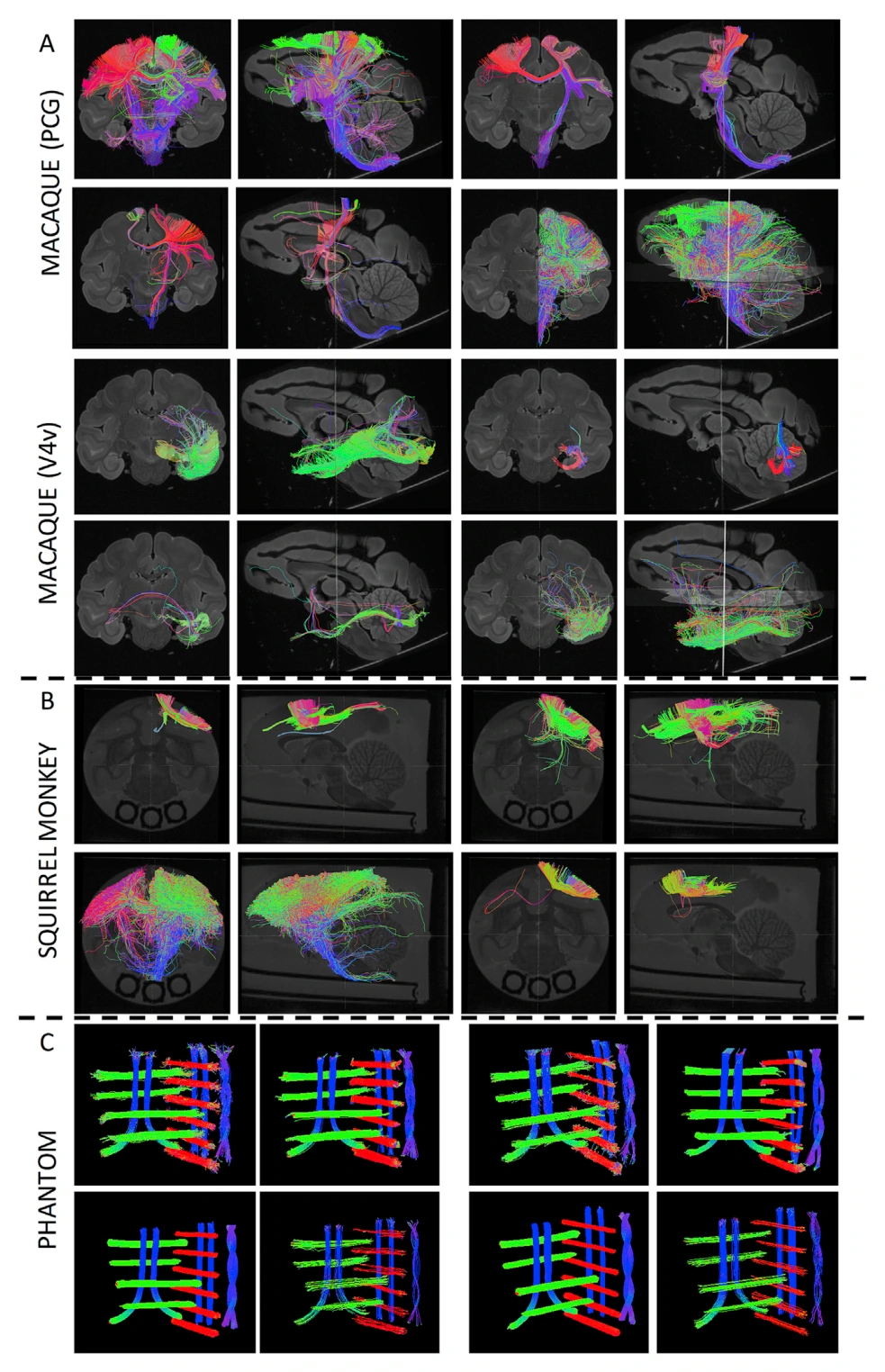
The 3-D Validation of Tractography with Experimental MRI challenge evaluated 176 submissions from nine research groups using three independent reference datasets: a physical phantom and two ex vivo primate brains. These datasets tested tractography under different fiber geometries, acquisition conditions, and definitions of anatomical accuracy. The central finding was consistent across the sub-challenges: contemporary approaches still faced substantial errors, and anatomical accuracy had not improved dramatically compared with established limitations. The study exposes tradeoffs that are difficult to see from visually plausible streamlines alone. Its conclusions concern the tested implementations and reference conditions, rather than establishing that every future or anatomically constrained method must perform similarly.
Main findings
- Nine groups submitted 176 tractography results across three independent validation datasets.
- Persistent anatomical inaccuracies were observed in both phantom and ex vivo brain tests.
- Modern methodological advances did not produce a dramatic overall improvement in the evaluated anatomical accuracy.
Cite this work
Kurt G. Schilling et al. · Last author: Bennett A. Landman (2019). Limits to anatomical accuracy of diffusion tractography using modern approaches. NeuroImage. https://doi.org/10.1016/j.neuroimage.2018.10.029
This page summarizes the work; consult the original article for the complete methods, results, and qualifications.