
2021 / NeuroImage / Article
Tractography dissection variability: What happens when 42 groups dissect 14 white matter bundles on the same dataset?
Summary
Forty-two teams dissected fourteen bundles from identical tractograms, revealing large differences in what researchers call the same pathway. Variation between dissection protocols exceeded within-protocol and between-person variation, demonstrating the need for clearer anatomical definitions and reproducible segmentation rules.
Study overview
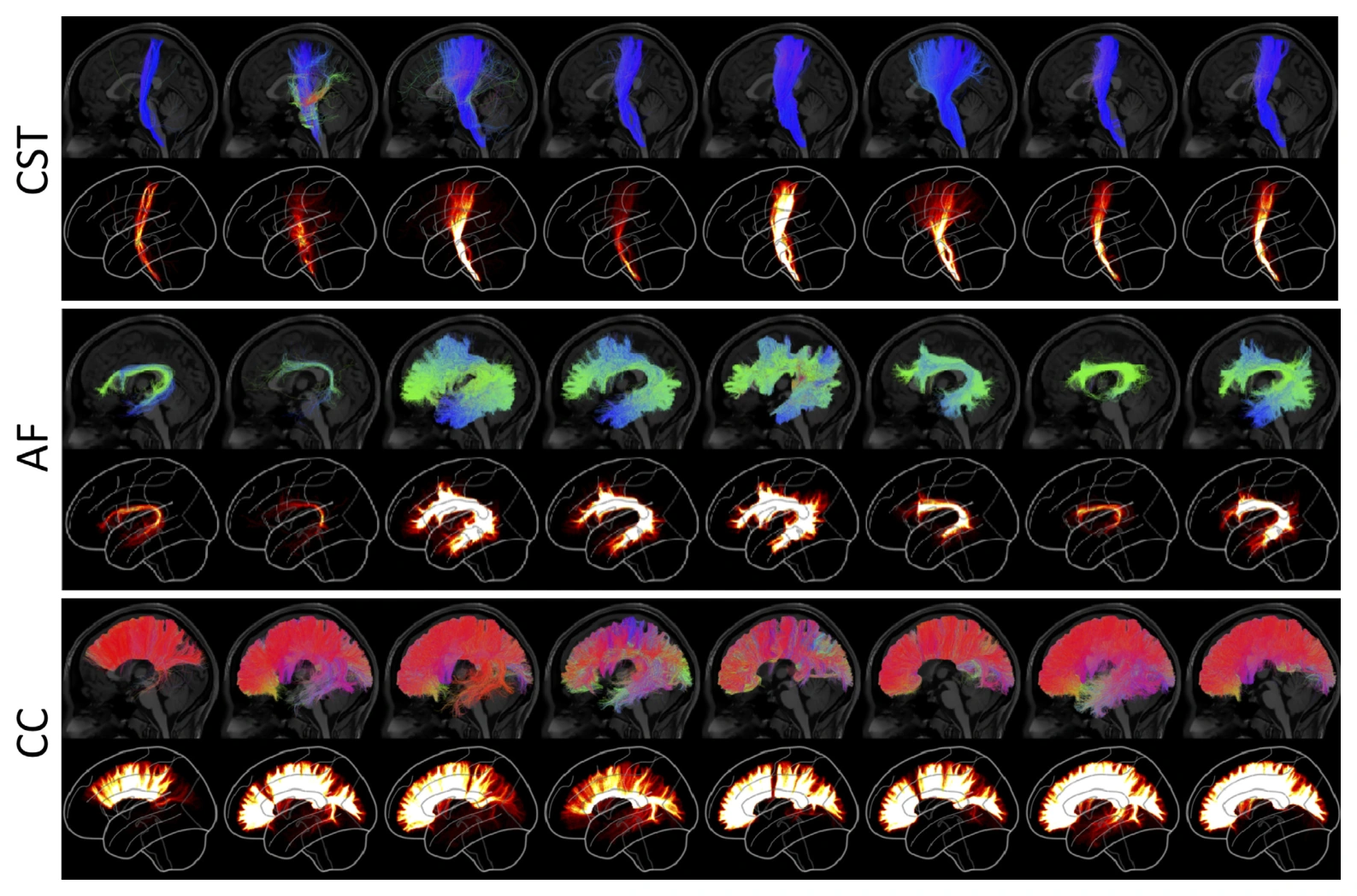
An open challenge gave 42 independent teams the same processed whole-brain tractograms from six subjects and asked them to identify fourteen white matter fascicles. The resulting 57 segmentation protocols were compared using both volume-based and streamline-based measures. Even with the underlying streamlines held fixed, differences between protocols were larger than within-protocol or between-subject differences. The study identifies nomenclature, anatomical definitions, and dissection constraints as major targets for improving reproducibility. It does not determine which reconstruction is anatomically correct: external validation is still needed. The limited subject sample and use of a shared tractogram also constrain generalization to other acquisitions and complete processing workflows.
Main findings
- Forty-two teams contributed 57 protocols for dissecting fourteen bundles in six subjects.
- Between-protocol variability exceeded within-protocol and between-subject variability despite identical input tractograms.
- Agreement alone could not establish anatomical accuracy; independent validation remained necessary.
Cite this work
Kurt G. Schilling et al. · Last author: Maxime Descoteaux (2021). Tractography dissection variability: What happens when 42 groups dissect 14 white matter bundles on the same dataset?. NeuroImage. https://doi.org/10.1016/j.neuroimage.2021.118502
This page summarizes the work; consult the original article for the complete methods, results, and qualifications.