
2022 / Cerebral Cortex Communications / Article
Anomalous and heterogeneous characteristics of the BOLD hemodynamic response function in white matter
Summary
White matter has a different BOLD hemodynamic response from gray matter, and the response varies within and between pathways. These differences also relate to diffusion MRI measures of tissue microstructure.
Study overview
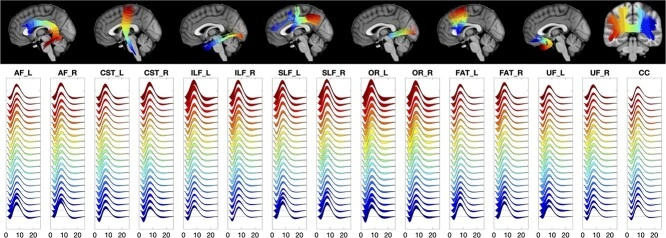
Using resting-state fMRI, this study characterizes the shape and spatial variation of the white matter hemodynamic response. Features including the initial signal dip relate to tissue microstructure and differ from those in gray matter. The findings show why a single gray-matter response model may be inadequate for analyzing white matter BOLD signals.
Main findings
- Response shapes differed between white and gray matter.
- White matter responses varied along pathways and were associated with microstructural features.
Cite this work
Kurt G Schilling, Muwei Li, Francois Rheault, Zhaohua Ding, Adam W Anderson, Hakmook Kang, Bennett A Landman, John C Gore (2022). Anomalous and heterogeneous characteristics of the BOLD hemodynamic response function in white matter. Cerebral Cortex Communications. https://doi.org/10.1093/texcom/tgac035
This page summarizes the work; consult the original article for the complete methods, results, and qualifications.